Research & Development World

  • R&D World Home
  • Topics
    • Aerospace
    • Automotive
    • Biotech
    • Careers
    • Chemistry
    • Environment
    • Energy
    • Life Science
    • Material Science
    • R&D Management
    • Physics
  • Technology
    • 3D Printing
    • A.I./Robotics
    • Software
    • Battery Technology
    • Controlled Environments
      • Cleanrooms
      • Graphene
      • Lasers
      • Regulations/Standards
      • Sensors
    • Imaging
    • Nanotechnology
    • Scientific Computing
      • Big Data
      • HPC/Supercomputing
      • Informatics
      • Security
    • Semiconductors
  • R&D Market Pulse
  • R&D 100
    • 2026 R&D 100 Award Winners
    • 2026 Professional Award Winners
    • 2026 Special Recognition Winners
    • R&D 100 Awards Event
    • R&D 100 Submissions
    • Winner Archive
  • Resources
    • Research Reports
    • Digital Issues
    • Educational Assets
    • Subscribe
    • Video
    • Webinars
    • PharmSci360
    • Content submission guidelines for R&D World
  • Global Funding Forecast
  • Top Labs
  • Advertise
  • SUBSCRIBE

Anthropic acquires a one-person biotech that used Claude to coordinate 11 labs

By Brian Buntz | October 27, 2026

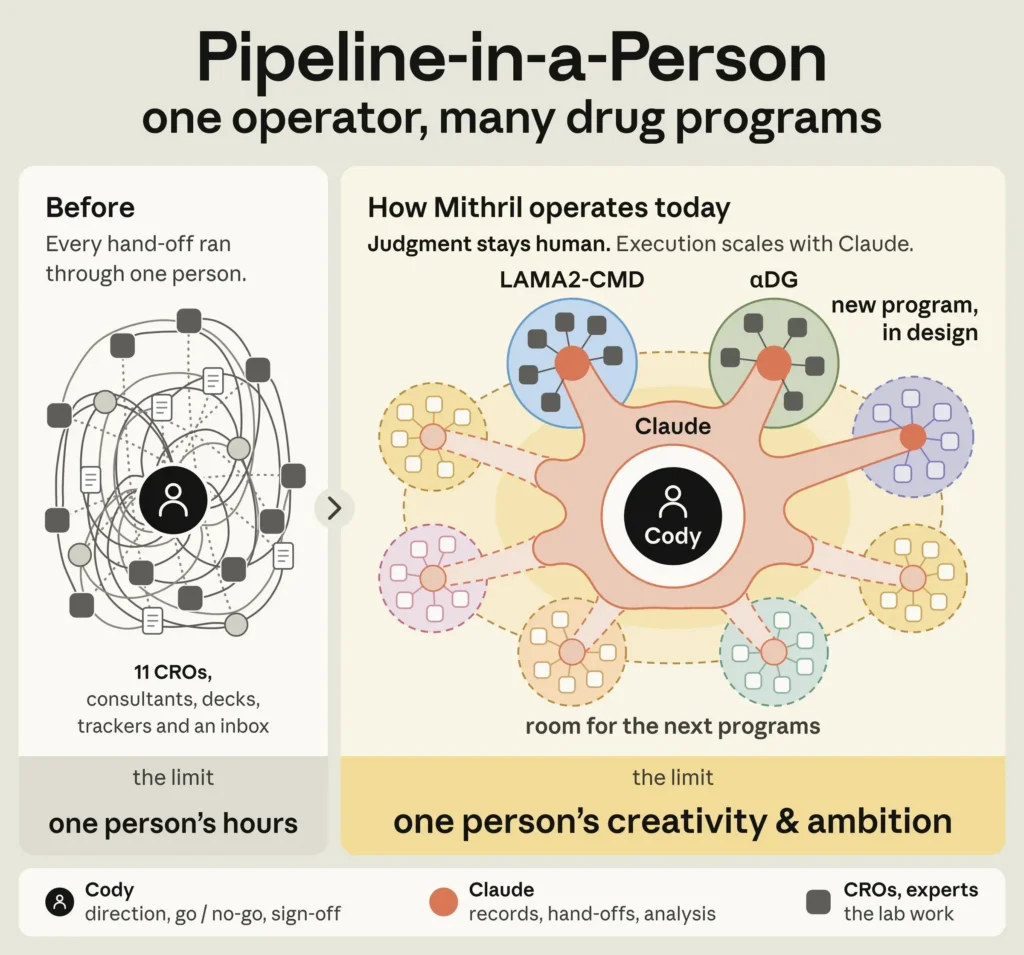
Pipeline-in-a-person

Credit: Anthropic

Two cofounders and fewer than 10 employees made up Coefficient Bio, the biology-focused AI startup Anthropic acquired in a deal R&D World covered in April. Another acquisition brings an even smaller company into Anthropic’s drug-development effort: Cambridge, Massachusetts-based Mithril Medicine had one full-time employee.

That employee, founder Cody Tranbarger, directed part-time scientific consultants and 11 outside laboratories, using Claude to help manage experiments, data and logistics. Anthropic disclosed Oct. 27 that it acquired Mithril in July. Its programs targeting two rare muscular dystrophies became Anthropic’s first internal drug-development programs.

Tranbarger brought experience across biotech finance and operations to that arrangement. A 2025 graduate of Harvard’s joint MS/MBA biotechnology program, he previously worked at Prime Medicine, a Cambridge-based gene-editing company developing therapies based on prime editing, and at Casdin Capital, a New York life-sciences investment firm focused on biotech and genomics. He later became an entrepreneur-in-residence at Atlas Venture, an early-stage Cambridge biotech venture firm that helps launch companies.

Behind the single-employee company stood eight paid consultants and advisers contributing expertise in biology, antibody engineering and research planning. Mithril’s team designed and oversaw the experiments; contract laboratories produced the antibodies, measured their binding, ran cell-based assays and conducted the mouse studies.

Mithril’s first results concern LAMA2-related congenital muscular dystrophy. Mutations in the LAMA2 gene, which encodes the laminin-α2 protein, weaken the connections anchoring muscle fibers to surrounding tissue. Building on earlier research into repairing those connections, Mithril developed bispecific antibodies that bind two targets to form a molecular bridge.

Anthropic says the company reached mouse proof of principle in under 18 months. The accompanying technical report, which awaits peer review, describes early research molecules. At roughly six weeks of age, seven mice receiving one antibody format showed about twice the grip strength and peak triceps force of four mice given a control solution.
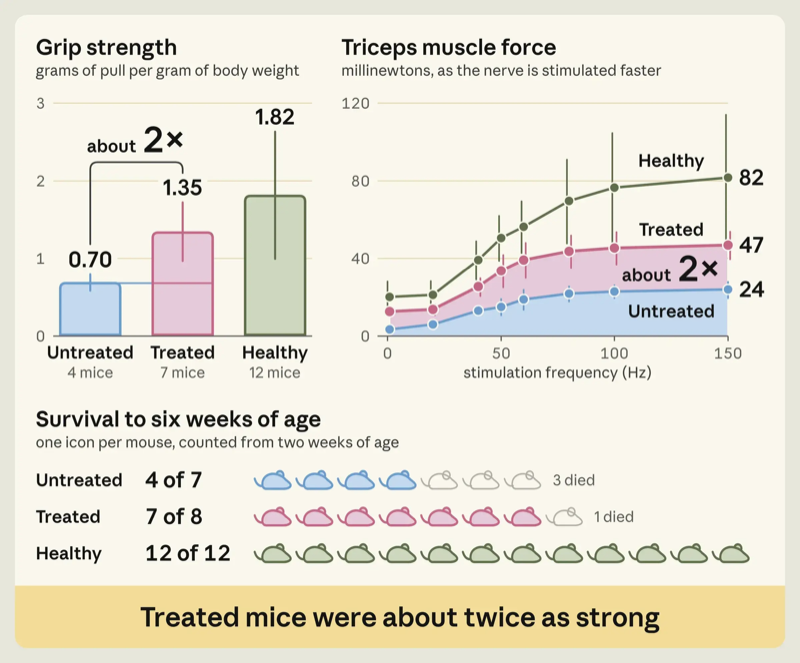
Charts comparing grip strength, triceps force and survival to six weeks in untreated, antibody-treated and healthy dyW mice

Credit: Anthropic

Researchers assigned treatment by litter without randomization and tested the antibody group 126 to 161 days after the control group, with a colony relocation in between. Those differences complicate attribution of the gains to treatment. The report calls for concurrent, blinded replication.

Alongside the mouse experiments, the report describes how Claude helped coordinate laboratory work. During a week the team selected as its best recent example, Claude synthesized a 341-page production report covering 113 antibody constructs in under eight minutes. When a team member overruled its recommendation to measure how quickly all 113 bound to and detached from their targets, Claude revised the plan and related drafts to cover 89 within four minutes.

Some errors survived human review. The team examined six Claude errors, at least three of which reached outside laboratories in emails people had edited and sent. One requested less material per tube than a laboratory needed; the team corrected it before filling began. Two errors in Claude’s review of production data went unnoticed for more than four days.

Anthropic calls this arrangement “Pipeline-in-a-Person” and plans to test it across additional rare-disease programs. Mithril aims to select formal drug candidates in 2027. Successful further development could put the LAMA2 program into human trials as early as late 2028. Its second program, for alpha-dystroglycanopathy, targets trials as early as 2029.

Tell Us What You Think! Cancel reply

You must be logged in to post a comment.

Related Articles Read More >

OpenAI logo glowing on a smartphone screen resting on a laptop keyboard
OpenAI says its AI models produced major proofs in mathematics, computer science and physics
Jellyfish: Claude Code bills hit $252 a month per developer as software factories automate code production among early adopters
Bar chart of first-half 2026 R&D: Anthropic $9.74 billion, above the ongoing R&D of Merck, Eli Lilly, Johnson & Johnson, Bristol Myers Squibb, Pfizer, AbbVie and Amgen
Anthropic’s R&D budget now rivals Eli Lilly’s
Two methane maps of the same EMIT scene: NASA's standard L2B enhancement, grainy with two small outlined plumes, above MAPL-EMIT output showing elongated plumes against a clean dark background.
Google AI finds more methane plumes in NASA satellite data
rd newsletter
EXPAND YOUR KNOWLEDGE AND STAY CONNECTED
Get the latest info on technologies, trends, and strategies in Research & Development.

R&D World Digital Issues

Fall 2025 issue

Browse the most current issue of R&D World and back issues in an easy to use high quality format. Clip, share and download with the leading R&D magazine today.

R&D 100 Awards
Research & Development World
  • Subscribe to R&D World Magazine
  • Sign up for R&D World’s newsletter
  • Contact Us
  • About Us
  • Drug Discovery & Development
  • Pharmaceutical Processing
  • Global Funding Forecast

Copyright © 2026 Arrowfly LLC. All Rights Reserved. The material on this site may not be reproduced, distributed, transmitted, cached or otherwise used, except with the prior written permission of Arrowfly
Privacy Policy | Advertising | About Us

Search R&D World

  • R&D World Home
  • Topics
    • Aerospace
    • Automotive
    • Biotech
    • Careers
    • Chemistry
    • Environment
    • Energy
    • Life Science
    • Material Science
    • R&D Management
    • Physics
  • Technology
    • 3D Printing
    • A.I./Robotics
    • Software
    • Battery Technology
    • Controlled Environments
      • Cleanrooms
      • Graphene
      • Lasers
      • Regulations/Standards
      • Sensors
    • Imaging
    • Nanotechnology
    • Scientific Computing
      • Big Data
      • HPC/Supercomputing
      • Informatics
      • Security
    • Semiconductors
  • R&D Market Pulse
  • R&D 100
    • 2026 R&D 100 Award Winners
    • 2026 Professional Award Winners
    • 2026 Special Recognition Winners
    • R&D 100 Awards Event
    • R&D 100 Submissions
    • Winner Archive
  • Resources
    • Research Reports
    • Digital Issues
    • Educational Assets
    • Subscribe
    • Video
    • Webinars
    • PharmSci360
    • Content submission guidelines for R&D World
  • Global Funding Forecast
  • Top Labs
  • Advertise
  • SUBSCRIBE